Learning about coagulation by reading words is like trying to make friends while dressed as a clown, holding an axe, standing in a a cornfield in the middle of nowhere. Don’t make things hard for yourself. Draw a picture!
But the coagulation cascade looks long and complicated!
That’s just how it LOOKS…in actuality it’s as easy as 12,11,10,9…observe:
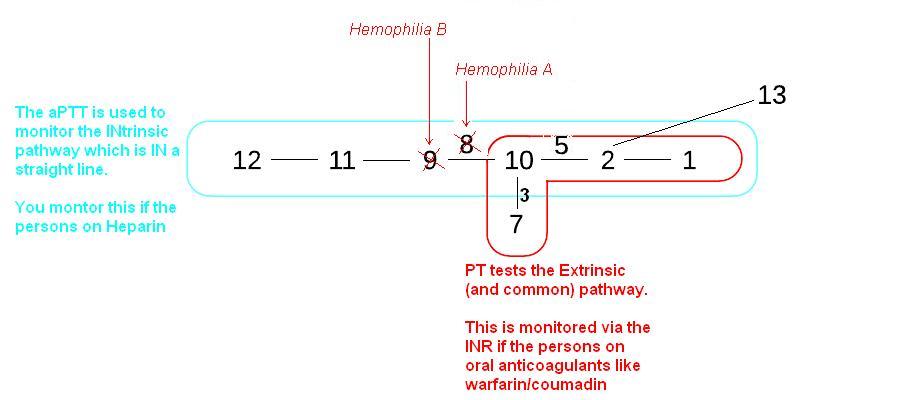
- Write out the factors from 13 to 1 - backwards. You don’t need to differentiate between a particular factor and its activated form (for example, 10 and 10a) because they all become activated
- 4 and 6 don’t exist
- 10 is special so it’s out of order
- 7 is lucky so it’s below the others
- 3, 5, 8 are helpful mates (they help along particular steps of the pathway)
- 13 is unlucky so it’s not related “2” anything
- The factors IN a straight line are part of the INTRINSIC pathway. The aPTT (which has more letters) monitors this pathway (which has more factors)
- On the other hand, PT (which has fewer letters) monitors the Extrinsic pathway (which has fewer factors)
Once you’ve got a handle on the above, notice that you can remember various other facts about the coagulation cascade using observations like, “10 is a special number so those factors surrounding it - 2,7,9,10 - need vitamin K” , or *“lack of factor will result in disease”.*The following diagram helped me learn much of coagulation, in conjunction with the text. However, it’s not enough. Do lots of questions with this diagram in mind. I hope it helps.